Advertisement
Discover 8 of the best castles in France, from medieval forts to lavish châteaux

Kerry Walker
Jan 16, 2026 • 11 min read

The stunning exterior of Château de Chambord reflected in the castle moat. Sylvain Sonnet/Getty Images
There was a time, hundreds of years ago, when the French royalty and nobility collected châteaux the way others collect stamps. Everyone wanted a piece of the palace pie, and as a result, France is sprinkled with some 40,000 châteaux, spanning epochs and flaunting their historic clout. This artistic sensibility and love of great, beautiful things that is so very French.
But not all châteaux are created equal: from elegant manors to mighty crag-clutching forts in the Pyrenees, castles laid to romantic ruin to the exquisite necklace of turreted Renaissance palaces strung along the Loire Valley, you’ll find that some grip you with their looks and others with their backdrops and bloody history. These are our absolute favorite castles in France.

1. Climb to the formidable fort of Château de Montségur
Best for dramatic mountain views
You can almost hear the stampeding hooves, crusading battle cries and clank of armor as you peer up at the great fist of rock punching above the wooded valley with the ruined fortress clinging to its top. Set against the cinematic backdrop of the French Pyrenees, in sun-scorched southern France’s Vallée de l’Ariège, Château de Montségur is the westernmost of the string of Cathar castles reaching across into Languedoc.
Advertisement
A medieval religious sect, the Cathars were in many ways quite ahead of their time – they were strict vegans who wanted equality, rejected the Catholic doctrine as immoral and believed in reincarnation. One thing is for sure: they knew how to build a good castle, even though it was here that they suffered their heaviest defeat in 1242 when the castle fell after an intense nine-month siege. Local legend has it that the Holy Grail was smuggled out of the castle to safety just before the defeat. The small Musée de Montségur in the village showcases archaeological finds from the eponymous mountain and highlights the castle’s history.
Planning tip: The castle is a stiff 20-minute climb up from the village of Montségur. Avoid the midday sun and bring plenty of water.

2. Unleash fairy-tale fantasies at Château de Chambord
Best for sheer grandeur
Even Walt Disney couldn’t have dreamt up a château more sensational than the UNESCO-listed Château de Chambord, deep in the central Loire Valley, an hour’s drive east of Tours. Imagine the most perfect French Renaissance palace built on the scale of the Taj Mahal. Of all the ludicrously romantic Renaissance chateaux in the drowsy, river-woven Loire, this one has the fairy-tale edge, with its harmonious symmetry, silver witch-hat turrets, cupolas and domes, immaculately landscaped formal gardens, and wooded park home to stags, mouflon and wild boar.
The showpiece of the Loire châteaux, the palace is incredibly grand, but no one ever lived in it. François I started it as a weekend hunting retreat in 1519 but plans mushroomed, and the palace quickly went off the charts in terms of budget and scale: 426 rooms, 282 fireplaces and 77 staircases. After three decades and immeasurable expense in the making, François deemed his new pad "too drafty" and stayed here for just 72 days during his 32-year reign.
Plan to spend a full day here, as there is much to see, including 18th-century kitchens, lavish royal bedchambers and the extraordinary double-helix staircase – allegedly designed by Leonardo da Vinci to stop the king’s wife from running into his mistress. With an interactive guide, maps and a treasure hunt for kids, HistoPad is great for a digital romp around the castle.
Not to miss: As if the château’s proportions weren’t stately enough, come in the morning or late afternoon, and you’ll see it magnified due to its reflection in the still, mirror-like waters of the Cosson Canal.

3. Marvel at the Pyrenees from Château de Foix
Best for medieval history fans
Mountains rise sheer and rugged like natural ramparts above this knockout of a triple-towered castle in Ariège in the eastern French Pyrenees, midway between Toulouse and the Spanish border. You’ll pinch yourself when you clap your eyes on this fantasy fortress, perched eyrie-like atop a crag. With its riot of turrets, towers and crenellations, this medieval beauty of a Cathar castle was the final stronghold of the powerful ruling Comtes de Foix. From the 16th century onwards, its fate took a darker turn as it was used as a jail.
The real magic comes as you approach on the cobbled track from the old town. While the castle’s bare interior may be anticlimactic, the battlements command astonishing views of the Pyrenees and the lushly wooded peaks of the Vallée de l'Ariège. Linger in the valley to explore rivers, caverns and waterfall-splashed canyons.
Planning tip: Spend some time strolling the narrow streets of the Foix’s medieval Old Town, which is as pretty as mountain towns get. For food, check out Noï, which puts a creative spin on traditional French dishes.

Advertisement
4. Rewind to medieval times at Alpine Château d’Annecy
Best for visiting in warmer months
Reclining on the northern shore of its glittering turquoise lake and peering dreamily up to the French Alps, Annecy has a chilled-out southern vibe you wouldn’t expect in an Haute-Savoie town just an hour’s over-the-mountain drive west of ski central Chamonix.
And, it has a rather fabulous château: a perfect chess-piece castle of ochre-stone towers and terracotta turrets that presides over the jumbled rooftops and web of emerald canals that form the Vieille Ville (Old Town). A fine example of a medieval castle, the château was the stomping ground of the counts of Geneva during the 13th and 14th centuries, a military barracks in the 1940s, and was classified as a historical monument in the 1950s.
Visit the château’s museum for a shot of culture in the form of regional art, medieval sculpture, Savoyard furniture, Alpine landscape painting and contemporary art. The views stretch across Annecy and its lake to the peaks of the Parc Naturel Régional du Massif des Bauges.
Planning tip: Your ticket grants access to both the Château and the Palais de l'Isle, so make time to visit both.

5. Revel in Richard the Lionheart tales at Château Gaillard
Best castle to visit in Normandy
If you prefer mist-swirled forts to fancy palaces and brooding ruins to bombastic interiors, the cliff-hugging Château Gaillard in Normandy will have you in raptures. An hour south of Rouen, this heart-stopper of a romantic ruin towers above the quaint village of Les Andelys on a particularly scenic bend in the Seine River.
Created out of the rock, the castle looks like the mad genius of a bold and ambitious king. It was built by Richard the Lionheart in the 12th century to guard the Seine River approach to Normandy and secure the western border of English territory until Henry IV ordered its destruction in 1603 (it first fell in 1204). When it was completed, word has it the king declared it gaillard, which can be translated as "saucy," "strapping," or "defiant" (take your pick).
The magnificent bastion certainly impresses with its inner bailey, upper court and dungeons. But it's the views from the château grounds that stay with you, especially as sunset golds render the castle into silhouette and the Seine twists away into the watercolor distance.
Not to miss: With a terrace overlooking the St Savior Church of Petit-Andely and the village’s main street, Le Café du Petit Andely is a great spot for a leisurely coffee at the footsteps of Château Gaillard.

6. Get lost in Loire romance at Château de Villandry
Best for beautifully landscaped gardens
Following the meandering Loire River west of Tours brings you to this resplendent Château de Villandry. You might do a double take when you see its stately but mismatched appearance – all harmonious Renaissance beauty but for the keep of the medieval feudal fortress that was otherwise razed to the ground in 1532. The donjon pays homage to the place where Henry II of England (Henry Plantagenet) admitted defeat to King Philip Augustus of France, signing the La Paix de Colombiers treaty two days before he died.
Unlike many, this palace wasn’t built for royalty but for Jean Le Breton, who served François I as finance minister and ambassador to Italy. You’ll see his passion for art and far-flung lands in the Oriental drawing room, with its gilded Moorish ceiling and gallery of Spanish and Flemish art.
Le Breton was fond of Italian Renaissance gardening, and it shows. The château’s landscaped gardens shine with fountains, cascading flowers and vines, impressive topiary and box hedges. Exploring, you’ll come across the Jardin d'Eau (Water Garden), the hornbeam Labyrinthe (Maze) and the 16th-century-style Jardin des Simples (Kitchen Garden), where cabbages, leeks and carrots are laid out to create nine geometrical, color-coordinated squares. Don’t leave without getting a view of the Loire and Cher rivers from the top of the keep and three belvédères (hillside panoramic viewpoints).
Planning tip: Visit between April and October to see the beautiful gardens in full bud and bloom.

7. Live the fantasy of the Sun King at Château de Versailles
Best for seeing an iconic European castle
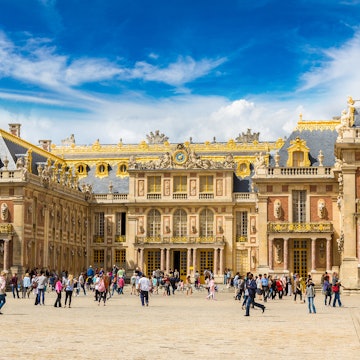
If you were Louis XIV back in the 17th century, with all the riches you could desire, France’s future at your fingertips, a court at your beck and call and an ego as big as an elephant, what better way to exert your influence than by building Versailles – a palace to outpomp them all, which projected the might of the French monarchy when it was at its most powerful. And it was built on a scale that beggars belief (700 rooms, 2153 windows, 67 staircases, paintings laid 11km end to end, 5000 objets d’art – you get the picture).
Sparing no expense, the Roi Soleil (Sun King) enlisted the most ingenious artisans of the age: architect Louis Le Vau, painter and interior designer Charles Le Brun and landscape gardener André Le Nôtre for this task. Together with 30,000 workers, the artists managed to decorate every last inch of the palace with gold leaf, frescoes, marble, intricate wood carvings and scenes drawing richly on Greek and Roman mythology – swiftly and efficiently draining the country's coffers as they did so.
And my, my is the result magnificent. Not without reason do 10 million people flock from Paris and far beyond to the leafy, bourgeois suburb of Versailles to see the palace par excellence each year. Prepare to be blown away by the Grands Appartements du Roi et de la Reine (King’s and Queen’s State Apartments), with rooms devoted to Hercules, Venus, Diana, Mars and Mercury, and the staggeringly opulent Galerie des Glaces (Hall of Mirrors), a 75m-long ballroom with 17 huge mirrors on one side and, on the other, an equal number of windows looking out over the gardens and the setting sun.
The formal gardens are as sublime as the palace itself, with their geometrically aligned terraces, dancing fountains, flower beds, mythological sculptures and Grand Canal, oriented to reflect the sun that Louis XIV worshipped so ardently.
Planning tip: Truth be told, Versailles can seem intimidating to first-timers, so planning is everything. Book tickets online to skip the queue, take into account opening times (it’s closed on Monday and at its busiest on Tuesday, Saturday and Sunday), arrive early morning and download the app for an audio guide and map of the estate. To see off-limits areas of the palace, pre-book a guided tour.

8. Fall for the Renaissance charms of Château d’Azay-le-Rideau
Best for fairytale lovers
Swirling in Renaissance romance, 16th-century Château d’Azay-le-Rideau, a short hop south of Tours, is quite possibly the Loire Valley château of your wildest dreams – a graceful, perfectly proportioned vision of creamy stone, steep slate roofs and silver turrets, vainly admiring its reflection in the waters of its moat. On an island in the middle of the Indre River, it’s so lovely you half expect a Disney princess to come wafting out of the door any second.
Your spin of the château will undoubtedly take in the splendid Italian-style loggia staircase overlooking the central courtyard, embellished with salamanders and ermines – the emblems used by François I and Queen Claude. The largely 19th-century interiors were fashioned by Marquis Charles de Biencourt (who bought the château after the Revolution) and his heirs. The lovely English-style gardens were restored and partly replanted from 2015 to 2017; the Jardin des Secrets (April to September) features heritage vegetables and flowers.
Planning tip: Audioguides are available in five languages; one-hour guided tours in French are free. In the Pressoir (the outbuilding to the right as you exit the ticket-sales hall), there's a worthwhile exposition on construction methods and materials, decorative motifs and the restoration of antique furnishings; the videos of experts at work are fascinating.
General tips on visiting the castles in France
Many travelers will commence their French château adventure from Paris. The great news is that many spectacular castles can be easily reached from the capital on a day trip. Versailles is one of the closest palatial masterpieces to Paris and is well-served by SNCF trains.
It’s the Loire Valley, though, where you find the biggest concentration of châteaux. Stretching from Orléans to Angers along the Loire River, it’s home to over 300 castles. To have the best visiting experience without rushing it, make a list of the palaces you want to see and stick to it. This will also help you to choose the towns to base yourself in.
Reaching the Loire Valley from Paris is relatively easy using TGV trains. Tours is located in the heart of the UNESCO-protected region, making it a popular base for exploration, though you will still need a rental car or ride share to reach many of the châteaux.
Advertisement
Explore related stories
Aug 26, 20258 min read
Why you should add cultural Rouen (with its own Notre Dame) to your France itinerary