Advertisement

Ramses II statue in the Grand Egyptian Museum (GEM) near Cairo. hemro/Shutterstock
The Grand Egyptian Museum (GEM) fully opened to the public on November 4, 2025 after the Tutankhamun Galleries and the separate Khufu’s Boats Museum were installed into the museum complex. The 12 other galleries have been publicly accessible since October 16, 2024.
Covering an area of 500,000 sq m (about 70 soccer fields) of which 92,000 sq m is the museum section and 40,000 sq m is the commercial section, this is the world’s largest archaeological museum complex dedicated to a single civilization.
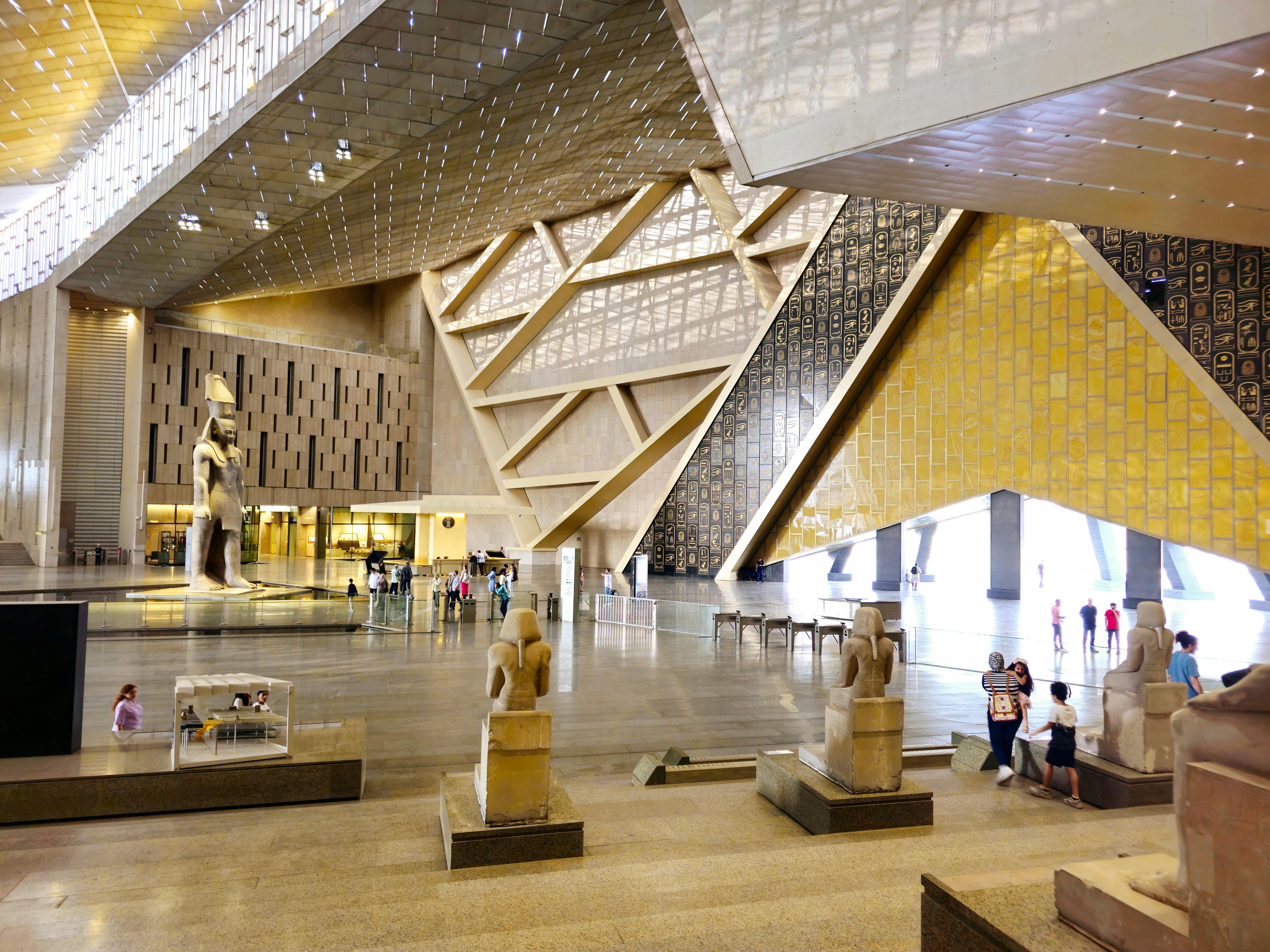
Fronted by a spectacular alabaster and glass facade, the complex is decorated with different sizes and colors of triangles – an ode to Ancient Egypt. Even the stones, over which water tinkles in the shallow rectangular pools that decorate the vast esplanade between the ticket office and the main building, are pyramidal.
The top of the building lies level with the Pyramids of Giza plateau and descends to the Nile Valley where the principal entrance for visitors lies.
Advertisement

When did the Grand Egyptian Museum project begin?
The building was designed by an Irish firm, Heneghan Peng Architects, who beat 1557 competitors from 82 countries to win the Egyptian Ministry of Culture’s 2003 competition to create a museum complex to house, display and preserve the tens of thousands of ancient treasures in its trust.
Construction began in 2005 but the 2011 Arab Spring brought work to a halt throughout the 3 years of political instability that followed. Tourist numbers dropped sharply during this period resulting in a corresponding drop in income for the government. But from 2014 onwards work was able to resume on the project, with considerable financial and technical help from Japan. And now, finally, it is fully open and the 3200-year-old, 82-tonne statue of Ramses II welcomes visitors into the vast atrium, 7 years after he arrived there himself!
How do I get to the Grand Egyptian Museum from Cairo?
For the moment the only way to get there is by Uber or taxi, or by hiring a driver or joining a tour.
In the future there will be a metro stop at the site that will make it easy to reach from downtown Cairo. For the time being it’s a bit tricky getting here by public transport. I tried by taking the metro to Cairo University (the closest stop) and from there I had to walk along a busy highway to the main University gate for an Uber to find me and drive me the remaining 18km to the GEM.
This trip cost me LE120 and probably wouldn’t have cost much more for the extra 6km from the city center! Don’t even try taking one of the local microbuses unless you speak Egyptian Arabic.
You may find it hard to get an Uber from the museum because the internet connection outside is spotty and many drivers still don't know where the pickup location is, but you may be able to grab a taxi that's just dropped somebody off or you can use the more expensive (LE400) museum limo service from outside the ticket office to return to your accommodation at the end of your visit.

Where do I buy tickets for the GEM?
At the time of writing the rules are that you must buy your ticket for a given day and a given time online only. The museum has suspended on-site ticket sales until further notice. However, the rules about buying tickets changed on a daily basis in the weeks after the museum officially opened because it was mobbed, mostly by Egyptians keen to explore this wonderful display of their heritage.
The museum’s official cap is 20,000 visitors per day but chief executive Ahmed Ghoneim has admitted the museum has sold up to 27,000 tickets a day, so it’s best to check the museum’s website. This is the only place you can buy tickets – do not buy off anyone trying to sell you tickets elsewhere.
How much are tickets for the GEM?
In December 2025, the cost for an adult over the age of 21 is LE1450 and for children (aged six to 21) is LE730. Entry is free for children under 6.
Advertisement
If you want a guided tour (in English and Arabic only) the fee for an adult is LE1950 and for a child LE975. For a private tour in a different language contact booking@legacy.com.eg.
The entry fee for Egyptian nationals is LE200 for an adult between the ages of 21 and 60 and half that for everyone else. Expect the site to be very busy with Egyptians on the weekends (Friday/Saturday).
What are the opening hours for the GEM?
The GEM complex is open from 8:30am to 7pm daily and 10pm on Saturdays and Wednesdays. The museum galleries are open every day from 9am to 6pm (last tickets sold at 5pm) with extended hours until 9pm (last tickets sold at 8pm) on Saturdays and Wednesdays.
How much time should I spend in the GEM?
That really depends on what you want to see. When the museum opened in 2024 I spent all day in the 12 galleries. On a recent return visit, I spent 6 hours just admiring the more than 5000 objects in the Tutankhamun Galleries and another hour in the Khufu’s Boats Museum. So that makes 2 whole days to see more or less everything.
The museum suggests a 2-hour path through the Tutankhamun Galleries (there’s also a 20-minute suggested path but that’s like going to the Louvre in Paris and only seeing the Mona Lisa!).
If you’re in a hurry and want to combine a visit to the GEM with the Pyramids of Giza just 2km away – you’ll eventually be able to walk between the two when the pedestrian walkway is completed – then visit the Giza pyramids first while it’s cool and the sun is behind you. If you visit in the later afternoon the sun sets behind the Sphinx and all you’ll see is a silhouette. You can then have lunch at the GEM and spend the hottest time of the day in the museum’s cool interior. Even if the museum is very busy, the excellent acoustics absorb most of the noise.

What will I see in the Grand Egyptian Museum?
Everything to do with the Pharaonic period from 3050 BCE to 394 CE except for the royal mummies, which are respectfully displayed in the Mummies Hall of the National Museum of Egyptian Civilization. I highly recommend a visit here too whilst you’re in Cairo!
The galleries of the GEM are arranged in three pillars: Society, Kingship and Beliefs, each of which is divided into four groups of periods.
The first covers the era between c 700,000–2034 BCE combining the Prehistoric, Predynastic, and Early Dynastic Periods together with the Old Kingdom and the First Intermediate Period. The second spans the period from c 2034–1550 BCE, covering the Middle Kingdom and Second Intermediate Period. The third covers the New Kingdom (c 1550–1069 BCE). The fourth covers the Third Intermediate, the Late and the Greco-Roman Periods spanning from c 1069 BCE–394 CE.
The visitor flow is very well thought out, so if, for example, you are only interested in the history of Kingship then start your visit in gallery 2 and walk straight ahead down the length of the building through galleries 5, 9 and 11. If, on the other hand, you’re interested in Society and Kingship and Beliefs during the New Kingdom then you start in gallery 7 and walk across the building into galleries 8 and 9. Each gallery is clearly numbered and has a plan that shows you where you are, making it very easy to plan your visit by period, or by theme, or just to simply wander.
Labelling is also well thought out: the print (in English, Arabic and braille) on the information panels is big; the panels are sloped so there are no reflections from overhead lighting and, even more importantly, the information is short, sharp and to the point and never takes more than a minute to absorb. At the right of each display case you’ll see a panel with a colored background. That will give you an overview of the general subject in that display case: for example, the role of High Priests. The panels with a gray or white background give you details about specific artifacts in that case.
What's in the Tutankhamun Galleries?
The Tutankhamun Galleries are accessed from gallery 7. It is arranged in five sections: Discovery (of his tomb), Lifestyle (his personal possessions), Rebirth (concept of the afterlife), Funeral (preservation of his body and the treasure he was buried with) and Identity, where there is a remarkable video recreating the young king’s face based on his skull. The majority of these objects and artifacts had never been exhibited before.
What's in Khufu’s Boats Museum?
The two oldest wooden boats in the world are exhibited in this separate building, which you can visit with your GEM ticket, at the back of the main museum across a lovely plaza with a fountain. There you’ll see the 42.32m-long wooden boat discovered in 1954 dismantled and buried in a pit under limestone blocks under the sand at the southern foot of the Great Pyramid of Khufu at Giza. It took 10 years to reassemble the boat and it was moved here in August 2021.
A second boat was found in the same place but extraction only began in 2014. It will be reconstructed under visitors’ eyes in this museum.

Can I take photographs or sketch in the GEM?
Private personal photography and video recordings are allowed with both SLRs and phones as long as you don’t use a flash or tripods or monopods, except in the Tutankhamun Galleries where ONLY mobile phone photography is allowed.
Sketching is allowed throughout the museum as long as you use only pencils (pens and markers are prohibited throughout the galleries) and that your sketchbook does not exceed 46×62cm.
Is the GEM accessible?
The GEM is accessible, and everyone gets to the galleries’ entrance from the same place on the left of the atrium. For those who want to admire the stone objects that line the monumental staircase, you wander up the 148 steps to the top from which there is a spectacular view of the Giza pyramids and the entrance to the galleries. For those who are in a hurry to get into the galleries or have infants in strollers, for example, you can use the moving walkway that rises slowly just alongside the right of the steps. For those with mobility issues, there is a platform between the rising and descending walkways onto which a wheelchair can be pushed. Wheelchairs are available at the ticket office.

What should I wear to visit the GEM?
Like anywhere else in Egypt dress conservatively. As the museum is air-conditioned you’ll need a light sweater or jacket – and comfy shoes of course!
Can I eat and shop in the GEM?
In the atrium, opposite the monumental staircase, you’ll find a food hall with Zooba, 30 North, Bitter Sweet, Beano’s Café, Ratio’s Bakery, Starbucks, Dolato, Ladurée and Mandarine Koueider to choose from.
Apart from the museum shop, which sells souvenirs and books, there are three upmarket jewelry shops and one, Atef Wassef, a family-owned silversmiths that sells in-house designed, modern, affordable silver jewelry. There’s also a couple of handbag shops, a carpet store, a body-care products establishment. Others shops will most likely fill the few retail spaces still available.
What other facilities are there at the GEM?
You’ll find an ATM, free lockers, a clinic, restrooms, a prayer room, mobile charging stations, a lost and found desk and information desks, conference facilities, gardens, an educational center and, coming soon, a library, a cinema and a co-working space. There’s even a small convenience store!
Advertisement