Advertisement

Watching in penguins in Wilhelmina Bay. Jeremy Fratkin
So you’ve been dreaming of Antarctica, and you’ve got nothing but questions: when should I go? How long should I spend there? How can I get there and not go bankrupt? Is my going to Antarctica a moral failing and going to have a negative impact on our planet? How much or how frequently will I throw up?
Luckily, I recently sailed on a 10-day Silversea cruise through the Antarctic Peninsula, so I’ve got at least some of the answers; unluckily, whether you get sick is not something I can predict or even prevent, but I’ve got tips on how to manage it. (Note: I did not avoid it.)
So strap in, and get ready for the trip of a lifetime, full of otherworldly beauty, penguins, whales, seals and icebergs galore.

Advertisement
Pre-departure
All these questions darted around my mind from the minute I booked the trip and stayed with me all the way to South America. Our ship, the Silver Cloud, set sail from Puerto Williams, Chile, across the Beagle Channel from the more frequent point of departure for Antarctic cruises, Ushuaia, Argentina. Silversea charters planes from Santiago, Chile to Puerto Williams for all passengers on its Antarctic sailings.
I learned quickly that plans for Antarctica are not set – the morning we were due to fly to the ship, we received a WhatsApp alert that our departure was going to be delayed by 8 hours. And while the first charter flight, thankfully the one we were on, made it to Puerto Williams without incident, the others were diverted to Puerto Arenas because the weather turned. Instead of setting sail that night, our departure had to wait until morning. This chaotic start was a proper introduction, and it would not be the only time that weather changed our course.

Crossing into another world
The conditions during an Antarctic cruise are unpredictable. Days start out with 50mph (80km/h) winds and zero visibility, and end with near-blinding brightness and blue skies. You’ll wake to a sea that looks like glass, only to find yourself hanging on for dear life as the ship lists from the power of two concurrent storms suddenly whipping up intense winds and swells on either side of the vessel.
The first two days on the Drake Passage were choppy, but not the stuff of nightmares. This time was both an introduction to the vessel, but more importantly, a chance to get to know our expert Expedition Team. They provided a detailed overview of our forthcoming adventure, with repeated warnings that that all plans can change. They also scheduled enrichment lectures and briefings to prepare us for landing on the peninsula. It felt like the first few days of school.

Awestruck in the Lemaire Channel
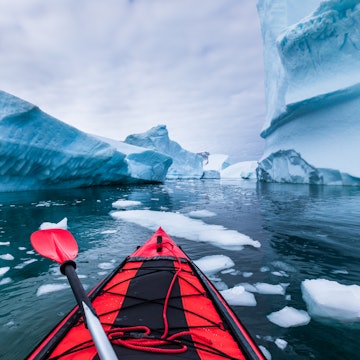
On day three, we saw our first glimpse of Antarctica’s glorious otherworldly beauty: the Lemaire Channel. We sailed slowly past ice floes and icebergs, floating like abstract sculptures, and snow-covered rocks jutting from the surface.
As I walked from bow to stern, taking pictures and trying to stay calm, I realized everyone, and I mean everyone, was losing their mind. It was like a group trance; whether to take pictures or just take in the beauty had all of us fumbling with our cameras and phones, looking at each other with bewildered awe, communicating with our eyes, if not our words, that we couldn’t believe what we were seeing.
As the intensity of our first encounter settled into something quieter, I realized how much we would be relying on all the members of the ship’s expedition team to translate this overwhelming place into something we could safely and responsibly experience.

The only constant in Antarctica is change
During our five days sailing the peninsula, our team leader, Marieke repeated about 25 times per day – whether over the ship's PA or at the daily recaps and briefings – the goal is to get passengers outside, onto Zodiacs, to experience the landscapes and wildlife up close, on land or on the water. But no matter what the intentions, the safety of the passengers and crew are paramount. Weather is in charge and adjustments will be made moment to moment.
Advertisement
In one day we attempted three landings, but were blocked by either wind or ice or both. As our voyage progressed, the captain had to adjust our course multiple times, even once turning the vessel completely around, to avoid a slow-moving lingering storm system, with 45 knots of wind (not quite hurricane force, but still severe).
Visiting Antarctica responsibly
Also paramount is protecting this fragile environment. Antarctica tourism is governed by IAATO (International Association of Antarctica Tour Operators), and the team explicitly and routinely communicated requirements for our going ashore.
Our first day on the Drake, we attended a mandatory “Going ashore in Antarctica briefing,” as well as a biohazard screening of our gear, to ensure we understood the policies and procedures to keep ourselves and Antarctica safe. Bird flu is a major concern, so the crew constantly communicated the importance of sticking to protocols to minimize any contamination risk.


Excursions and wildlife
Following a slippery landing, and in weather conditions that were cold, wet and gray, we eventually made it onto terra firma at Hogvaard Island. Here we we encountered our first colony of gentoo penguins, birds that slip and slide in the snow, constantly fighting for footing, even though these icy conditions are their natural habitat. The aroma of their collective poop, pungent but tolerable, was a constant. So was their squawking.
On another day – one that was so bright and shiny in contrast – we took a Zodiac cruise through Wilhelmina Bay. The air was crisp, the sky a stunning shade of azure. The water beneath the icebergs, too, was an equally vibrant shade of blue just under the surface.
Of all the penguin species we might see during our expedition, we were told not to expect to see any emperor penguins – sightings in this part of Antarctica were near impossible. While out in a Zodiac looking for whales, John, the crew member who was piloting the boat, took a sudden change of direction towards an iceberg, excitedly radioing all the other Zodiacs to join us. As we slowed to get a closer look at the bird on the iceberg he exclaimed with enthusiasm "We never see emperors here!” It just goes to show, you really should expect the unexpected in Antarctica.
John also spotted a couple of humpback whales nearby. We motored in that direction and the radio communication among the Zodiac drivers continued, all of us trying to capture a photo or a video. John helped us anticipate the appearance of the whale tail to make sure we could get the shot. He also picked up some ice from the water, to examine its composition, the universe of bubbles within. As instructed, I rubbed it like a genie in a bottle, lifted it to my ear to hear the most magnificent crackling sound. I swear it felt as if the ice was speaking to me.
After we returned to the ship, the captain found the miracle emperor penguin and the whales again, slowing to a near stop so we could all see these magnificent animals one more time.

Taking the polar plunge
One of the things I most looked forward to on this expedition was the oft-mentioned and highly anticipated polar plunge. Again, the crew made sure the conditions were just right to drop anchor and spend a few hours allowing more than half the passengers to make their way to the starboard side of the ship in their bathing suits, robes and slippers.
I went down and was all jitters. I stripped down to my bathing suit and bare feet and allowed the crew to secure my waist with a harness before stepping on the starboard side of the Zodiac from which I flung myself. The nerves violently turned to shock – yikes it was cold, a couple of degrees over freezing. The urgency with which I returned to the surface, flailing my arms while screaming expletives. It wasn't exactly swimming, but I was quickly climbing the ladder to get out and get warm. Thing is, after being in a sea that chilly, I did not need a robe or anything. Anyway, it was such a rush! It felt like the perfect end to the trip.
The expedition concludes
We had a much rougher crossing on the return to Puerto Williams; despite using the transdermal scopolamine patch I was prescribed, the motion sickness hit me hard. I spent the last two days on the Drake Passage in bed.
Ginger candies, ginger ale, crackers, apples: we tried everything to settle my upset stomach, but alas I went down. I’m generally not prone to sea sickness, so I was both surprised and sad to miss out on the camaraderie of the remainder of the trip. The Drake Passage is no joke and it can be very rough indeed, but don't let that put you off embarking on this fantastic experience.A

How to make it happen
Is Antarctica for me?
This is the most important question. One needs a sense of adventure, a willingness to be remote and at the whim of the seas, and have a good level of mobility and fitness. There were some people with mobility issues on the ship who didn’t participate in the more intense of landings, but were able to see a lot from the ship’s decks. There are soft adventures too, where the more challenging aspect, such as hiking to a summit or getting in a kayak, is optional.
And if you're seasick-prone, well, it's a tough call. I myself did not believe I would be seasick and yet. So if you're not okay with even the possibility of feeling woozy to nauseated, this may not be the trip for you.
How much does a trip to Antarctica cost?
Cruises to Antarctica start at $6000 for a bare bones experience. For a luxury cruise line like Silversea, the price can soar into the tens of thousands. It’s not impossible to get a deal on a luxury ship (deal being relative), but I've seen last-minute 8-day cruises from $12,000 per person on Silversea based on double occupancy. You also have to factor in the hotels and flights and any gear you might need to rent. On all ships, prices depend on the length of the voyage, the room type you choose and whether you skip the Drake Passage entirely and spend even more money to fly there.
When should I go to Antarctica?
There’s only one season for visitors who are not scientists, and that is the austral summer: November through March. The best (and peak) months to go are December and January, the optimal period for viewing wildlife, birds (such as Antarctic tern and albatross), humpback whales and orcas, chinstrap penguin, and the elusive emperor penguins.
Because this is the most desirable season, prices are highest during these months, so if you wish to spend a little less, go earlier or later in the season.
What do I need to pack?
Silversea supplies each guest with a parka (that you can take home – make sure you have space in your bag), and you can rent the waterproof pants and boots required for excursions. The most essential items for Antarctica are as follows:
Base layers
Hats, gloves, gaiters
Sweaters
Wool socks
Phone or camera
Comfortable shoes that slip on and off
Sturdy sunglasses and lens wipes
Bathing suit for the polar plunge (there’s also a steam room, sauna, an outdoor pool and two hot tubs)
Motion sickness remedies (pills or a prescription scopolamine patch)
Meditating on the extraordinary privilege of seeing this part of the world, I wish everyone could visit Antarctica, where the predominant feeling is gratitude for our beautiful planet. It's quiet and reflective, and a reminder of how small and insignificant we all are, but in a good way!
Brekke Fletcher was a guest of Silversea. Lonely Planet does not accept freebies in exchange for positive coverage.
Advertisement
Explore related stories


Apr 4, 202217 min read
This is your brain on Antarctica: penguins, icebergs, and a lifetime supply of awe